Early History in Te Tai o Poutini
Te Tai o Poutini features prominently in the early Māori history of occupation in Aotearoa/New Zealand and is named after Poutini, the taniwha who accompanied Ngahue on his voyage from Hawaiiki. Poutini is also rendered as the taniwha who abducted Tamaahua's wife Waitaiki and turned her to pounamu, and who swims along the coastline protecting people and pounamu. The regions rich geological resources were investigated and utilised for centuries prior to the arrival of Pākehā. During these centuries, travel pathways were created by successive generations, relying on cumulative mātauranga (knowledge) to successfully navigate the landscape. Geographic features such as mountains, rivers and ranges were given names attributed to memorialise people, events, resources or physical characteristics. Nohoanga, mahinga kai and mahinga toi were dotted along rivers and plains along with inland kainga at Ohinetaketake near Ahaura, Takataka and Te Kainga at Kotukuwhakaoko (Lake Brunner), although the majority of kainga were located on the coastline and mostly within a day's walking distance of each other. The Ikamatua and Inangahua awa were utilised as part of the ara pounamu (travel routes) for expeditions to extract and trade for pounamu. Waiuta translates as ‘inland water’ in Te Reo Māori, but the name itself is not directly associated with Māori history in this place. Rather, it was an invented name, part of a late nineteenth and early twentieth century trend in ascribing Māori place names to postal and railway settlements on the West Coast.
When Pākehā began arriving in the area in the mid-19th century, Ngāti Waewae played a key role in assisting the visitors and newcomers with surveying and exploration. Brunner coal was known and utilised for warmth before the Pākehā arrived, and it was Māori who first discovered the gold so coveted by the Pakeha, opening up the goldfields of Waimangaroa, Karamea and Lyell in Buller, as well as Hohonu and many of the other great goldfields of the West Coast, including here in the upper Grey Valley.
West Coast Gold Mining
Gold mining was responsible for the initial large scale Pākehā settlement of the West Coast and provided prosperity. Māori continued to provide transport and guidance as well as storekeeping and mining, for example at Waimangaroa (north of Buller), Westport, Karamea and at Lyell Creek. As alluvial sources dwindled, hard rock mining of the ‘mother lodes’ took over and was important in extending the life of the industry for many decades. Gold-bearing quartz had, in fact, been discovered in the Inangahua District as early as 1866 but as the goldmining industry found out all too often, these reefs were difficult to access and unpredictable. A few early mines in the Reefton area turned out to be profitable and brought wavering prosperity to the area. The richest of the area’s mines lay undiscovered until it became a lucky prospecting find in the valley of Greek Creek, a Blackwater River tributary, in 1905.
Early Days at Waiuta
On 9 November 1905 a prospecting party of Ernest Bannan, Bill Meates, Dave Ross and Jimmy Martin found an auriferous quartz reef outcrop, which they named the ‘Birthday Reef’ because the discovery coincided with the birthday of King Edward VII. In early 1906 they sold their claim to a speculator, Percy N. Kingswell for £2,000 and then, with a massive effort expended on prospecting trenches to prove the reef, the site was on-sold in mid-1906 to the London-based Consolidated Goldfields Limited for £30,000. The company Consolidated Goldfields of New Zealand had been formed in 1896 by mining entrepreneur, David Ziman, and he was pivotal in developments at the site.
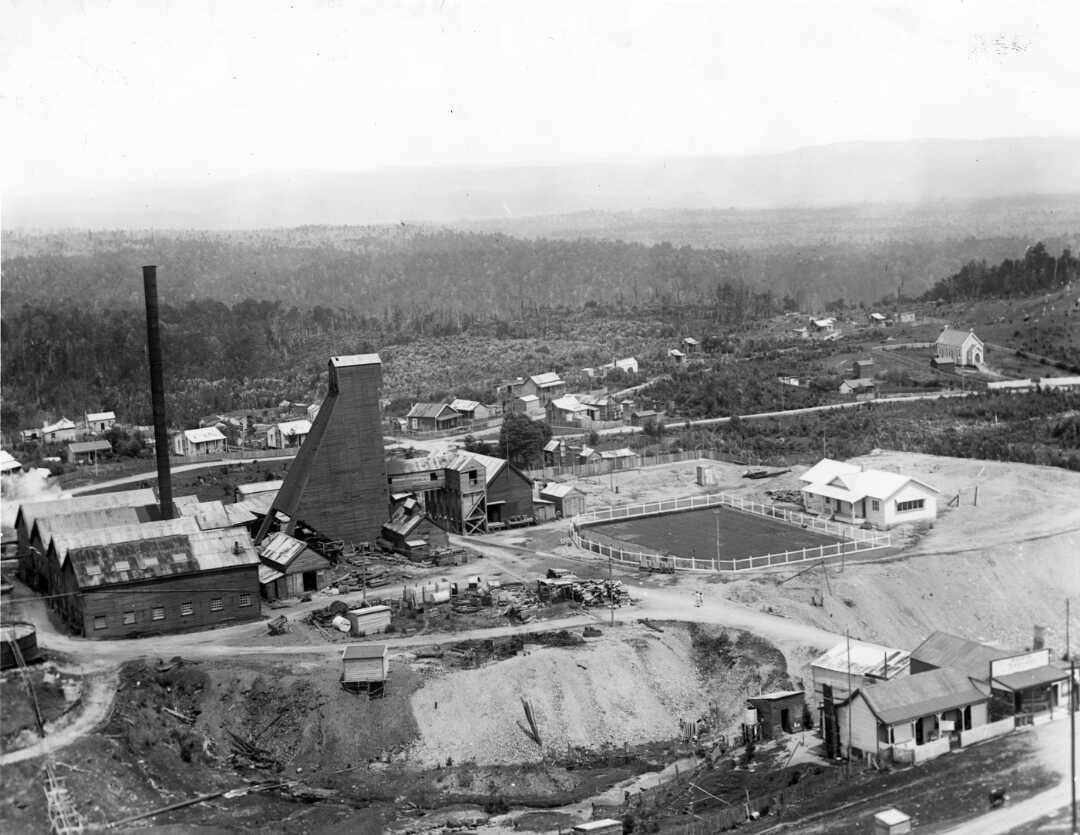
In March 1907 a subsidiary company, Blackwater Mines Limited, was formed to work on the reef and by this time a shaft was already being sunk. Winding gear and temporary head gear were installed to allow sinking of the shaft to 457 feet (139 metres) by September 1907, after which a semi-permanent poppet head was erected. At the mine shaft’s No. 2 Level, 90 metres below ground, a 450 metre tunnel known as the Joker level was being driven to connect the shaft with the Snowy River valley, some 900 metres away to the south. There a 30-stamp battery and processing plant, to crush quartz and extract the gold, was being planned. The Blackwater Mine was fully operational by 1908 and was profitable from the outset - a ‘picture of a mine’ for the company.
Snowy River Battery and Treatment Plant
The battery-site selected was steep and required clearing of dense bush and the construction of large concrete retaining walls. A sawmill was erected to provide timber for the machinery and battery house. By July 1908 the machinery for the battery was installed and a cyanide plant to treat the tailing sands was in the course of construction. By August 1908 the battery was busy crushing quartz.
Initially, between 1908 and 1910, the ore arrived via the incline from the Joker level. Gravity played a major part in feeding the material from process to process. Lumps of ore from the mine were dumped on a grill of heavy steel bars at the top of the battery complex, dropping into massive storage bins ready for crushing. The 30 stamps of the battery were set out in groups of five stamps within six mortar boxes. Automatic feeders from the storage bin released the quartz into the mortar boxes and water was added for the stamper crushing process, producing a pulp which was then taken via a launder (open timber flume) to the plate room.
Inside the plate room were v-shaped boxes where the pulp ran through to a spreader at the head of nine polished copper amalgamating plates smeared with mercury. As the slurry passed over the treated plates, gold flakes amalgamated with the mercury, each plate being carefully scraped each morning for the amalgam to be further processed.
The amalgamation process accounted for approximately 80% of the gold recovered at Snowy Rivery Battery. Balls of amalgam were heated in a retort, separating off the mercury and leaving behind impure sponge gold which was later refined. The result was molten gold poured into bars.
Following the amalgamation process the leftover pulp went through a size classification process in a hydraulic device (spitszkasten) which separated coarse pulp (sands) from the finer material (slimes). The sands went to Wilfley concentrators and the slimes were taken to cyanide vats. Thirteen large steel cyanide vats were built, each with a rotating distributor consisting of a central bowl from which six distributing pipes radiated. Sands from the spitzkasten and Wilfley concentrators (and later the roasted concentrates) were carried in launders to the bowls and after a settling period, were pumped with a sodium cyanide solution. The cyanide solution percolated through the sand, dissolving the gold, a slow process that was repeated three times with a successively weaker solution. After the third cyanide treatment, the gold-cyanide solution was run from the vats through to the zinc room while unwanted sands (with traces of cyanide) were washed down the Snowy River. The zinc room contained partitioned boxes fitted with gratings and filled with zinc shavings. The gold-cyanide solution was run through these zinc boxes, precipitating the gold via a chemical process as a slime ready for recovery by acid treatment and smelting.
Slimes that came from the spitzkasten were also treated by cyanidation, in four 12 metre tall ‘B. & M. agitator tanks’ which blew compressed air that allowed the gold to be dissolved in an oxygenated solution and then filtrated via a vacuum process and settlement in cyanide vats. It then followed the zinc room precipitation process as the sands had - that is, both slimes and sands processes went to the zinc room.
In 1910 Wilfley concentrating tables were installed. The coarse pulp (sand) that passed over the amalgamating plates was collected and washed over mechanically agitated tables called Wilfley tables, inclined tables covered with heavy linoleum and narrow wooden laths froming thin tapering depressions called riffles, while the remainder (sands or pulp) flowed over them. The heavier grains (concentrates) containing gold rich material and metallic sulfides sank into the riffles.
An assay office building was complete by October 1908. In 1909 a tube mill - a revolving
In 1911 a skip incline tramway was built, descending very steeply from about 500 metres east of Waiuta reaching the true right bank of the Snowy River.
Furnaces were used for various stages of gold recovery: driving off mercury from the amalgam, purifying gold-bearing sludge from the zinc boxes and finally smelting and purifying the gold. The gold bars were stamped BM for Blackwater Mine. An Edwards Roasting furnace was built in 1924 at the Snowy site. Revolving arms within the furnace agitated the sand to encourage oxidation, helping to get out the last of the bits of gold encapsulated in the ore. A side effect of the roasting was to drive off arsenic from the ore concentrates causing the killing or stunting of vegetation around the plant.
In 1935 another 10 stamps were added to northern (upstream) end of the crusher – this was the last major addition at the Snowy River site.
Power for the Snowy River machinery
The plant was largely water-powered. The main shaft for the stampers was driven by a Pelton wheel. Smaller wheels drove the Wilfley tables, air compressor and electric power generator. By October 1908 a two kilometre water-race was in operation, but this proved to be problematic in freezing or dry weather as there was insufficient or irregular power for the crushing machinery. To remedy these issues, and as more equipment was added, a suction charcoal gas engine was installed in 1910 as a supplementary power source. A retort to make charcoal from local mānuka timbers for the charcoal gas engine proved unsuccessful, however.
In 1923 a water race was completed from Staircase Creek (a tributary of the Grey River) and in 1924 this was extended to Absolum Creek (a tributary of the Alexander River). A licence for another water race was applied for in 1925 along the north bank of the Snowy River, starting at the battery tail race, to run an electric power generating station. In 1940 a power plant with cast iron Pelton wheels was erected on a new foundation to make use of the two main water supplies.
Mining operations changed in 1936. The North or Prohibition Shaft became the centre for quartz extraction. A 1.6 kilometre aerial ropeway was constructed to deliver its quartz to the Snowy River Battery (prior to this, from 1910 ore had arrived via a low-level horse tram, which had limited capacity for transporting ore to supply the battery, especially as the mining took place further north). By mid-1938 a new ball mill at the Blackwater Mines North (Prohibition) site eliminated the need for the battery at Snowy River, though it was still used for the cleaning up of untreated ore and tailings for a time. The Edwards roaster at the Snowy River site was dismantled and re-erected beside the new Prohibition ball mill.
Blackwater Mines North (Prohibition) Shaft and associated remains
Soon after the south shaft was sunk into the reef, various competitors had begun attempting to access the reef from neighbouring sections, including at the Prohibition lease on the hill north-east of Waiuta town. In 1909, a Westport syndicate under the direction of Sidney Fry conducted prospecting work there, including sinking and driving, but they failed to find anything payable. David Ziman strongly suspected the Birthday Reef lay below and, without his hoped-for backing from sceptical Consolidated board, raised his own capital to secure an option on the Prohibition lease in 1909. Limited support from Consolidated Goldfields did follow, but reluctantly. During 1910 and 1911 the Blackwater No. 2 level, 93 metres below the surface, was driven north to the Prohibition with crosscuts east and west, and an old surface tunnel northward from Greek Creek was extended, but nothing was found. Ziman’s perseverance in that space eventually led to his estrangement from the company and financial hardship. Ziman formed the North Blackwater Development Syndicate, which was registered in late 1915 with 39 shareholders. Later renamed North Blackwater Mines Limited,they expended considerable effort and sank a mine shaft as far down as 380 feet (115 metres) but that company’s finances gave out and eventually the Prohibition lease was cheaply acquired by Blackwater Mines Limited in around 1926. The shaft became the Blackwater North Shaft, or Prohibition Shaft. A lot of plant was already at the site when Blackwater Mines took it over, including engine and compressor house, boiler house, storerooms, poppet head, Tangye engines, tubular boilers, Bury air compressor, steam sinking pump, winding engine, sawmill and smithy iron.
Blackwater Mines soon drove its Nos 6 and 9 levels northward across the boundary. By 1932 the Blackwater workings were down to No. 12 level at 560 metres and work began repairing the Prohibition shaft and plant in anticipation of it becoming the centre of mining operations. When the shaft was deepened to No. 13 level, 716 metres below the collar, in 1935 it became (for the time) the deepest vertical shaft mined in New Zealand. Because of the depths being worked, a new electric-powered winding system was installed in 1936 to replace an earlier steam plant.
During reopening and development work, the Blackwater Mines South and North (Prohibition) Shafts were linked at No. 7 level to connect electric cables and compressed air pipes from the old workings to the new area and to improve ventilation. When they reached No. 12 level, an electric Sirocco exhaust fan was installed near the Blackwater South Shaft to help keep temperature down in the lowest levels.
To begin with (1936-38), quartz from the Prohibition mine was transported to the Snowy River battery via the 1.6 kilometre gravity-powered mono-cable aerial tramway. However, by early 1937 it became clear that most of the quartz was coming from the Blackwater North (Prohibition) and no longer the Blackwater South Shaft. The introduction in 1938 of an electrically driven ball mill near the Prohibition Shaft did away with the need for the aerial and stamper battery. Prohibition’s ball mill was New Zealand’s most modern quartz reduction and gold saving plant for its time. Instead of descending stamp crusher plants, as had been used on the West Coast for 70 years, it had revolving steel drums containing steel balls for primary reduction, a smaller tube mill for fine grinding and flotation cells for efficient gold-saving.
The Prohibition Shaft opened at No. 17 level at 300 metres below sea level (879 metres below the collar) in July 1951 but within days, on 9 July 1951, the Blackwater (South) Shaft collapsed below the surface. This destroyed the ventilation system and pumps, stopping all mining work immediately.
Waiuta – the Town
The first dwellings were canvas tents and makeshift huts used by the miners who ‘proved’ the reef. Once it became clear that the mine would be developed, from 1907 more comfortable dwellings began to be constructed. Blackwater Mines Limited knew from the outset that a sizeable labour force would be required and therefore a town with company-built accommodation was an early priority. Earlier thoughts of establishing a township about two kilometres to the west of the mine shaft were abandoned when residents preferred to establish themselves right beside the mine itself. By early 1907 there was a shop incorporating a post office, its owner being Mr Meates, one of the original prospectors who discovered the reef in 1905. It was Meates who chose the town’s name – Waiuta – from a selection of three names put forward by the ‘postal’ department.
By March 1908 the company had built a cluster of simple one-roomed huts, two-roomed cottages as well as some four-roomed cottages for families and a boarding house. In these early days, it was still a rough and ready heavily male-dominated settlement and all supplies, including vegetables, needed to be brought in from elsewhere. Conditions in the town gradually improved, roading was formed and more families arrived. Most of the houses built were, at the start of their life, classic weatherboard and iron two-roomed cottages, usually with corrugated iron chimneys, although larger houses for the managers of the mine were also built. In addition, a series of small miners’ huts (‘Red Huts’), without kitchens, were erected for the single men.
The roads and tracks developed quirky names. Examples of the tongue-in-cheek naming of parts of the town include ‘Nob Hill’ where many of the wealthier staff houses were located, Incubator Alley where many growing families lived, Shinbone Alley and Dingbat Flat near the Prohibition site.
By 1911 there were buildings standing on Bottom Road, Shinbone Alley, Battery Road and Incubator Alley. By 1913 more houses and businesses appeared in the town. Early public buildings included a miners’ union hall above Top Road (1910, destroyed by fire in 1941 but rebuilt the following year), a school at the east end of Top Road, an Anglican Church south of Bottom Road (1913), a cottage hospital (1914, half funded by subscriptions from the miners) and the Empire Hotel (before 1913) near the town entrance on Top Road. Boarding houses were also constructed, including two owned by Blackwater Mines Limited and rented to operators.
The Miners’ Union was key for the workers and the town. As part of the Inangahua Miners’ Union, Waiuta miners were among the first New Zealand workers to fight successfully for improved workplace health and safety to combat the lung disease known as miners’ phthisis. Lobbying efforts led to the Miners’ Phthisis Act (passed in 1915) which provided pensions to miners with silicosis as well as financial compensation for the widows and children of those miners who died from the disease.
Heydays of Waiuta town
The quartz reef proved to be very regular and the profitable mine supported a thriving community. Even through the 1928-35 Depression, Waiuta continued to experience full employment because gold, as an attractive security, rose in price. By the 1930s Waiuta had already taken on a well settled appearance. It had a police station, a proper post office, a second church (this one for the Catholics, built circa 1921), many facilities and some better quality houses compared to the rudimentary ones built earlier. Bungalows were built in the 1930s, mostly as staff accommodation provided by the company, two east of the recreation ground and others on Nob Hill east of the south shaft. Workers and their families tended to reside in more rudimentary accommodation on the lower lying areas of the town, though they also began to build their own houses or alter the ones built for them by the company. Many of the houses had well-tended gardens, with flowers and shrubs, fruit trees and vegetable gardens.
While most people lived in the main township of Waiuta, some lived in the Snowy Valley on the south side of the river in houses and huts and a boarding house, and later on some workers and their families lived around the Prohibition (North) shaft or at nearby Dingbat Flat.
Waiuta’s population was drawn from an international mining community, its inhabitants hailing from countries as diverse as Australia, England, Dalmatia, Denmark, Italy, Bohemia (now Czech Republic) as well as including Māori and earlier Pākehā settlers. The diverse community was particularly active in the arts, sports and social gatherings.
The place operated with workday and home life routines, with a strong sense of community interaction. The mining workforce was made up of men. Women carried out domestic duties but also had their own sports teams, a women’s institute hall, and a few were storekeepers or hoteliers. The miners’ hall was a centre of town life and its social events, including dances, musical and dramatic performances, and wedding receptions, were well known in the district.
The recreation ground, built by locals flattening a mullock heap, was the other main centre of town life – a key place where a whole range of sporting activities and games took place. These included rugby league, wood chopping, hockey, cricket, as well as school picnics, fairs and fetes.
Locals also built their own swimming pool, tennis courts, bowling green, whippet track and children’s playground. Although there was sometimes a class divide about where sport was played – for example there were two sets of tennis courts, one for the company staff and the other for the workers and their families – many places were for the whole community.
Waiuta was known for its sportspeople and some won national titles. For example, Stan Purton was the national amateur flyweight boxing champion in the mid-1920s and Ron King, the first boy born in Waiuta, became an All Black rugby captain in the 1930s.
The community as a whole was vibrant. While individuals and families made up Waiuta’s vital social fabric and mining expertise, there are three stand-out names often mentioned in conjunction with the place – David Ziman, Tasman Hogg and Joseph Divis.
David Ziman (1862-1920),
Influential mining entrepreneur, David Ziman, was born in Poland but lived in England and South Africa before coming to the Reefton Goldfield in the late nineteenth century, infusing much-needed capital to restructure the quartz mining industry there. Ziman’s London-based company, Consolidated Goldfields of New Zealand Limited, was formally incorporated in 1896 and involved international mining experts, representatives of the House of Rothschilds, an Earl, a Knight of the Realm. From 1900, the company was significant in producing a marked increase in gold production on the Reefton Goldfield and in 1906 it acquired the recently discovered Birthday Reef, becoming instrumental in developments at Waiuta’s Blackwater Mine. Through Ziman’s understanding of the geological uniqueness of the Birthday Reef, he also postulated it plunged further to the north of the Blackwater Mine, within the neighbouring Prohibition lease. However, this notion was derided by Consolidated mine management and led to Ziman having to raise his own capital in 1909 to secure an option on the Prohibition lease to the north and, eventually, falling out with his own Consolidated Goldfields Board. It took many years after the sinking of the Prohibition Shaft in 1909, and much angst, capital and diffident company involvement, before Ziman’s theory about the rich persistent Birthday Reef deep at the Prohibition proved to be correct. Unfortunately, after a career marked by volatile extremes, Ziman died in Hokitika in 1920 and so never lived to see this eventuality. Blackwater Mine Company, despite having previously disparaged Ziman’s Prohibition theory, cheaply acquired the lease and continued sinking Ziman’s shaft down until, in 1936, after it intersected the Birthday Reef, it became Waiuta’s main shaft in 1938.
Tasman Rangi (Te Rangi Tuangahuru Tahimana) Hogg (1883-1974)
Thames-born Tasman Hogg, often called ‘Tas’, was one of six children born to Scotsman, Alexander Hogg, and his Ngāti Maru wife, Te Arani Watana. He proved to be an exceptional student of mining and as a young man had worked in mines in Thames and then Western Australia. In 1914 Hogg and his wife Blanche moved to Reefton and then in 1915 to Waiuta, where he became Chief Surveyor at Blackwater Mine. In 1931 he became assistant mine manager and in 1935 was appointed manager, staying in that position until the mine’s closure in 1951. Hogg presided over Blackwater Mine during a period of significant change in mining and processing at the Prohibition site. He was one of the few residents of Waiuta of Māori descent and, fluent in both English and Te Reo Māori, he returned to Thames every two or three years to visit whānau and maintain his proud connections to Ngāti Maru. Hogg played a pivotal part in mining operations at Waiuta and, like so many, was very active in its community. He was involved in sports clubs, particularly tennis and bowls, and used his survey skills to help prepare the courts and greens. He also made an important contribution to mining education through the School of Mines and was a member of the Board of Examiners and a Fellow of the Institute of Mining and Metallurgy.
Joseph (Jos.) Divis (1885-1967)
Resident miner and photographer, Joseph Divis, left an outstanding legacy of high quality photographs that documented mining and community life at Waiuta between 1910 and 1935. Bohemian-born Divis had arrived in New Zealand in 1909, visiting Waiuta the following year and producing a series of postcards and images, Wondrous Waiuta, which were subsequently published in the Auckland Weekly News. In October 1912 Divis had his first of many stints of mining employment at Waiuta’s Blackwater Mine. He lived at Waiuta, on and off, from 1912 until the mid-1960s, many years after the mine closed. The first half of the 1930s was an especially productive time with his Waiuta photography and he had many images published. He captured posed images of people (often including himself) in work scenes as well as events such as the town’s Queen Carnival in 1931, weddings, jubilee celebrations, formal groups, theatrical productions, commercial scenes, and many more intimate family or household scenes. In 1932 he had purchased a cottage on Shinbone Alley after its former occupants, Percy Jones and family, were forced to leave due to ill health from miner’s phthisis. This cottage, now known as Divis Cottage, is one of the few surviving buildings still at Waiuta.
Decline
The mining operations came to an abrupt end in July 1951 with a collapse in the original Blackwater (South) Shaft. While the Prohibition (North) Shaft was the centre of mining operations by this time, the original south shaft was still essential for pumping and ventilation. The London-based directors of the company decided that repairs were not economic and so the mine closed. Workers and their families soon left Waiuta, many taking their houses with them. Waiuta was given ‘ghost town’ status from 1951, although a small number of residents did remain, albeit without electricity and only a single telephone line. Whereas in 1948 the town had a population of 500, by late 1953 there were only around 14, including two children. Picnickers occasionally visited, often gathering berries while there. In 1959 five houses in Waiuta were occupied by pensioners. Divis was one of the few residents who stayed behind, continuing to live in his Shinbone Alley cottage and acting as the town’s telephonist from 1957. Artist Toss Woollaston made repeat visits to Waiuta in the 1950s and 1960s, creating a number of expressive paintings of from that period. People came and went over the years. Long-time resident, Dick Willan lived in the former police station until his death in the late 1970s. A small number of alternative lifestylers lived in the old hospital for a few years. In 1986, the town’s three residents were Ossie McTaggart, Errol Clements and John Pedersen. In 1998 John Pedersen was reported as being the sole permanent resident at Waiuta.
Revival: Heritage Recreation and Interest
After most left town in 1951, vegetation began to cover over some of the sites. From the late 1970s efforts were made by some local workers at the New Zealand Forest Service, the department responsible for what was to become the Victoria State Forest Park, to record Waiuta’s history and encourage ‘heritage recreation’. An industrial archaeological site survey was made, interviews with former residents undertaken, and in 1985 a Friends of Waiuta group was established to arrange a reunion in 1986 to mark 80 years since the place’s inception. The remains of the derelict former hospital building were restored to become a lodge in 1985, rebuilt adjacent again in 1986 after the lodge was destroyed by fire. At the same time a brochure was prepared and ‘state of the art’ interpretation and general signage was installed on site reflecting 1980s outdoor presentation techniques. This work on interpretation and development at Waiuta was recognised in 1986 with a Tourism Design Award presented by the then Minister of Tourism, Hon. Mike Moore. The Department of Conservation formed in 1987 and continued this awareness, running school holiday programmes and open days. Books and articles have been written and documentaries made, including in 2020 ‘Whispers of Gold’. In December 2020 Waiuta was recognised as a Tohu Whenua site, a treasured heritage place that tells the stories of New Zealanders.
Decontamination/remediation
The Department of Conservation inherited a site that was highly toxic. The Blackwater Mines North (Prohibition) Mine was deemed to be the world’s worse water-borne arsenic site (nearly 600,000 parts per million). Contamination had occurred as a result of the process used to extract gold from arsenic bearing rock. A major decontamination and remediation programme was undertaken in 2016, resulting in 96 barrels of highly arsenic contaminated material being removed from the Prohibition site for treatment and appropriate disposal elsewhere.
Ever since the mine closed suddenly in 1951, there has been speculation that substantial quantities of gold remain below ground. In August 2020 a mining company confirmed it had the funds and permissions to invest in a mine drive from the Snowy River that will pass under the township to reach below-sea-level of the Blackwater Mine (this is below but outside the extent of the List entry).